The Health Effects of Daylight Savings
Written by Mariam Shahzad and Rhea Mittal
Every spring and fall, people across the United States adjust their clocks for daylight saving time (DST). While the goal of this practice was originally to conserve energy and make better use of daylight, researchers have started to question whether the time change may actually harm a person’s health. Medical experts say the one-hour shift can disrupt the body’s natural sleep cycle and increase the risk of certain health problems.
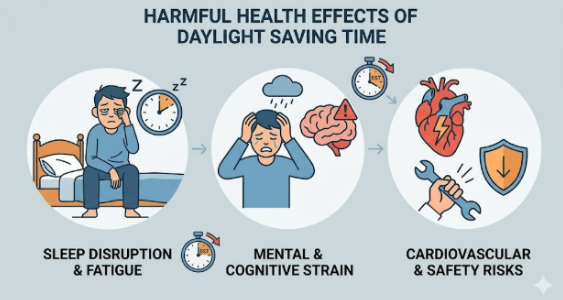
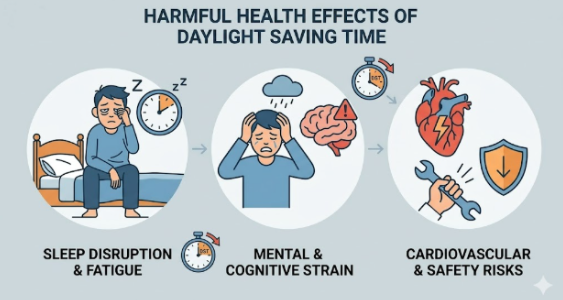
One of the biggest concerns is how daylight saving time affects the body’s circadian rhythm, which is the internal clock that controls when we feel awake versus sleepy. When the clock moves forward in the spring, many people lose an hour of sleep and have difficulty adjusting their schedules. According to sleep researchers, this disruption can lead to sleep deprivation and fatigue for several days after the time change (Rishi et al., 2020).
Lack of sleep doesn’t just make people feel tired, it can also have real health consequences. Some studies have found that the days immediately following the time change are linked to a small increase in heart attacks. Researchers believe that the sudden change in sleep patterns, combined with stress and changes in the body’s biological rhythms, may place additional strain on the cardiovascular system (Manfredini et al., 2019). In fact, some reports have shown that heart attack rates may rise in the days after the shift to daylight saving time has occurred.
Sleep disruption can also affect concentration and reaction time. Because of this, researchers have observed an increase in car accidents and workplace injuries during the week after clocks move forward. Losing even one hour of sleep can make it harder for people to focus, which may explain why these accidents occur more frequently during this period (Johns Hopkins Bloomberg School of Public Health, 2023).
Due to these concerns, some medical organizations have begun recommending that governments reconsider seasonal clock changes. The American Academy of Sleep Medicine has suggested adopting permanent standard time instead of switching clocks twice a year, arguing that it better matches the body’s natural sleep-wake cycle (Rishi et al., 2020).
Although daylight saving time has been used for over a century, research suggests that the health effects of disrupting sleep and circadian rhythms may outweigh its benefits. As scientists continue studying the issue, the debate over whether or not to keep daylight saving time is likely to continue.
References:
Johns Hopkins Bloomberg School of Public Health. (2023). 7 things to know about daylight saving time.
Manfredini, R., et al. (2019). Daylight saving time and cardiovascular health. Chronobiology International.
Rishi, M. A., et al. (2020). Daylight saving time: An American Academy of Sleep Medicine position statement. Journal of Clinical Sleep Medicine.