Neurofibromatosis and Its Challenges
Written By: Samira Esha, Sahannah Seemungal, Ihsaan Alam
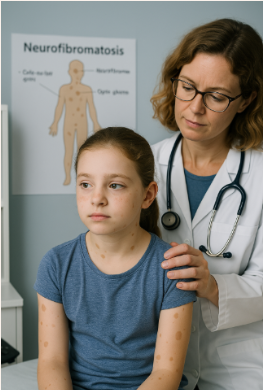
NF (neurofibromatosis and schwannomatosis) refers to a group of genetic conditions that affect approximately four million people worldwide. These conditions cause tumors to grow on nerves and can impact multiple body systems, including the skin, eyes, bones, and nervous system. While NF can affect people at any age, diagnosis in childhood is critical, as early signs can be subtle and the condition progresses over time. There is currently no cure, but the Children’s Tumor Foundation (CTF) and others are accelerating the development of treatments to help people with NF live longer, healthier lives. NF presents in one of several forms: NF1, NF2-related schwannomatosis, or schwannomatosis. NF1 is the most common form and is often diagnosed early in childhood. Children with NF1 may have multiple café-au-lait (light brown) spots on their skin, as well as bone differences, scoliosis, and about half have learning challenges. While the tumors that form are typically non-cancerous at first, some can become malignant and life-threatening over time.
NF2-related schwannomatosis (formerly known as NF2) is less common and can lead to brain tumors (meningiomas), spinal tumors and tumors on the auditory nerves, which can lead to hearing loss, balance issues, and other neurological symptoms. Schwannomatosis, the rarest form of NF, is actually a spectrum of conditions that usually present in adulthood and cause severe excruciating pain and other complications.
NF can be inherited from a parent or result from a spontaneous genetic change. In fact, about half of all cases are spontaneous, meaning there is no prior family history. Diagnosing NF can be challenging—not because symptoms always appear late, but because awareness among the public and professionals remains limited, and signs can be mistaken for unrelated issues.
While NF is rare, there is a robust and growing body of research focused on understanding and treating it. Two drugs have been approved and 60+ clinical trials are ongoing, and organizations like CTF are not just supporting research, they're actively changing the landscape of what's possible for patients. The Children’s Tumor Foundation plays a unique and catalytic role in NF research. It helps bridge the gap between academic science and pharmaceutical development, making it faster and more feasible to bring treatments to patients.
In an interview with the CEO of CTF, Dr. Annette Bakker, she emphasized the importance of the Foundation’s role in uniting partners across sectors. “In academia, publications and grants are needed to keep your research going,” she explained. “In pharma, confidential data and intellectual property will lead to the needed return on investment to keep developing novel therapies. But as a foundation, we’re neutral. We are unconflicted as we don’t have to publish or patent, but we have to go fast because we have the same sense of urgency as the patients. We have the ethical obligation to connect the right players and ensure that promising science leads to better treatments for patients.”
Because NF is rare, there are few scientists working on it, few preclinical models, few patients, and few clinicians. And with more than 10,000 rare diseases, the small patient populations often mean lower commercial returns than common diseases. “If no one helps, pharma companies are typically not so keen to work on rare disease—even though the Orphan Drug Act has significantly boosted financial incentives,” Bakker said. “CTF is here to help. We’ve built a network of top researchers and clinicians, a drug scouting effort to identify promising treatments, a preclinical hub that de-risks early-stage projects, and platform-basket trials to make NF more attractive to industry partners.”
NF is a rare condition that brings lifelong challenges and anxieties for many children, the adults and their families. Organizations like the Children’s Tumor Foundation operate on the nexus between patients and all stakeholders that are helping make progress possible. We are committed to help bring new treatment options and better care to those living with NF.
References:
Children’s Tumor Foundation. Children’s Tumor Foundation, https://www.ctf.org/.
Children’s Tumor Foundation. “Revised Diagnostic Criteria for Neurofibromatosis Type 1 Announcement.” Children’s Tumor Foundation, 10 May 2021, www.ctf.org/news/revised-diagnostic-criteria-for-nf1-announcement/.
Legius, Eric, et al. "Revised Diagnostic Criteria for Neurofibromatosis Type 1 and Legius Genetics in Medicine, vol. 23, no. 8, 2021, pp. 1506–1513. https://doi.org/10.1038/s41436-021-01170-5.