The Importance of UV Protection
Written By: Laila Ibrahim
As the weather begins to warm up and the sun’s rays shine brighter, it’s time to start protecting our skin from the harmful UV rays that make their way through the atmosphere. Though the sun is the provider of one of the most crucial vitamins (Vitamin D), it’s also one of the leading causes of skin cancer (and premature aging). In the United States, skin cancer is the most common of all cancers. Melanoma is the deadliest form of skin cancer, with an expected 104,960 people to be diagnosed in 2025, and approximately 8,430 people to die of Melanoma (American Cancer Society). Could this be prevented? For some, they are genetically predispositioned to developing skin cancer, however, for others, they fail to take the necessary steps to protect their skin, given their lifestyle.
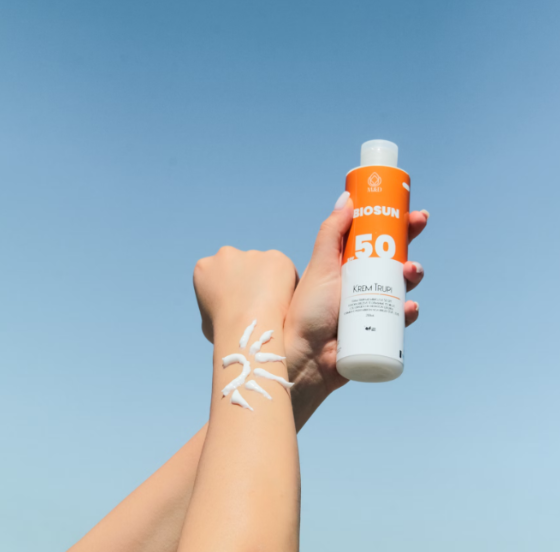
Some like to tan, others work long hours under the sun. In any of these situations, it’s crucial to wear sunscreen with a Sun Protection Factor (SPF) of at least thirty. Sun Protection Factor, or SPF, is one of the most effective and widely used forms of sun protection. SPF ranges from two to one hundred, and the number indicates how long the sunscreen will be able to protect you from UVB rays. SPF 30 and SPF 50, are most commonly used and protect you from 97% to 98% of UVB rays.
But how does sunscreen work? Sunscreens contain organic and inorganic compounds that block ultraviolet radiation. Ultraviolet radiation is light with shorter wavelengths shorter than visible light; the shorter the wavelength the greater possibility that the light radiation can cause damage to cells (The Efficacy and Safety of Sunscreen Use for the Prevention of Skin Cancer). There are two types of sunscreens, mineral sunscreen, and chemical sunscreen. Mineral sunscreens contain compounds, such as Titanium Dioxide, and Zinc Oxide. These chemical compounds reflect UVA and UVB rays, and spread them, before they can penetrate the skin. Chemical sunscreens contain chemicals such as avobenzone, oxybenzone, octoxinate, and octisalate (Mineral Sunscreen - MSU). These ingredients act as a filter, they absorb UV rays, and the harmful energy from the absorbed rays is converted into lower-energy wavelengths, taking less of a toll on the skin (The Efficacy and Safety of Sunscreen Use for the Prevention of Skin Cancer).
In order to pick the best sunscreen for yourself, it’s important to understand your skin first. Mineral sunscreens are the better option for those who have sensitive, and easily irritable skin, however, they can leave a white cast. Chemical sunscreens are better suitable for those with normal skin, as well as those who prefer sun protection without a white cast!
As much as sunscreen can help protect skin against harmful rays, there are those who are genetically predisposed to getting skin cancer, as well as those who are more prone to it. A family history of skin cancer is a sign of a genetic predisposition. Having freckles, or albinism, can make someone more prone to getting skin cancer. It’s important to know the signs and symptoms of skin cancer. New growth on skin, such as a scab, mole, or bump, is indicative of cancer. Itchy, painful skin, or a non-healing sore, may also be signs. If you notice any of these changes, consulting with a healthcare provider is important for proper diagnosis and treatment as early detection can significantly improve outcomes.
Alongside UV protection, a diet high in vitamin C, can aid in not only the production of collagen, but can also prevent sunburn. Skin is our largest, yet most sensitive organ, it’s crucial to take all the necessary steps to protect it from harm!
References:
Sander, Megan, et al. “The Efficacy and Safety of Sunscreen Use for the Prevention of Skin Cancer.” Canadian Medical Association Journal, vol. 192, no. 50, 13 Dec. 2020, pp. E1802–E1808, www.ncbi.nlm.nih.gov/pmc/articles/PMC7759112/, https://doi.org/10.1503/cmaj.201085.
“Trending – Mineral Sunscreen.” Center for Research on Ingredient Safety, 7 May 2024, cris.msu.edu/news/trending/trending-mineral-sunscreen/.
American Cancer Society. “Melanoma Skin Cancer Statistics.” Www.cancer.org, 12 Jan. 2023, www.cancer.org/cancer/types/melanoma-skin-cancer/about/key-statistics.html.
Mayo Clinic . “Skin Cancer - Symptoms and Causes.” Mayo Clinic, Mayo Clinic, 6 Dec. 2022, www.mayoclinic.org/diseases-conditions/skin-cancer/symptoms-causes/syc-20377605.