
A World of 3D Printing
Written By: Rhea Mittal and Samira Esha
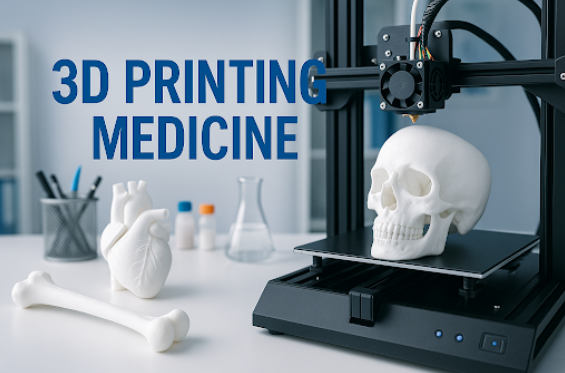
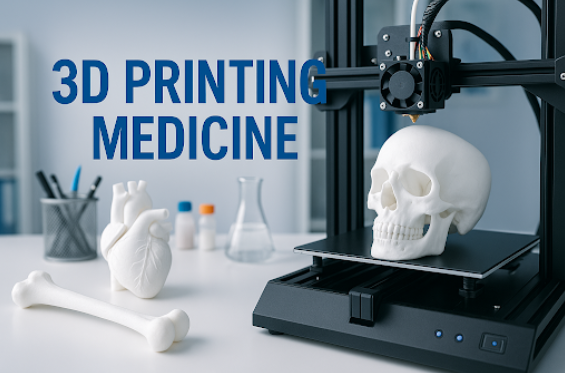
The medical field is exploring and adopting 3D printing technology. Once limited to industrial design and manufacturing, 3D printing is now used to improve surgical precision, reduce health complications and even create human organs in the lab. These developments are reshaping healthcare and offering new hope for patients needing customized treatments or organ transplants.
In recent years, hospitals and research institutions have begun integrating 3D printing into medical procedures globally. From creating patient-specific surgical models to printing tissue and organs that mimic the human body, this technology is changing how doctors treat disease and plan operations. Two major uses of 3D printing in medicine are improving complex surgeries through custom planning tools and guides and advancing the science of bioprinting, which can lead to the production of fully functioning human organs.
A groundbreaking project is underway at the All India Institute of Medical Sciences (AIIMS) in Bhopal, India. The Department of Urology, led by Dr. Ketan Mehra, is using 3D printing to make kidney surgeries more accurate and less risky. The team is focusing on a procedure called Percutaneous Nephrolithotomy (PCNL), which can remove kidney stones that are large or located deep within the body.
Traditionally, PCNL requires surgeons to rely on 2D scans to plan their approach. With 3D printing, doctors can create a life-sized model of the patient's kidney, based on CT scans. This allows them to study the stone’s exact size, shape and position before the surgery begins. Not only does this improve planning, but it enables the creation of custom surgical guides. These can help surgeons know exactly where to insert the instruments, reducing the risk of damaging healthy kidney tissue. According to the AIIMS team, this approach can reduce surgery time, blood loss and improve patient recovery.
While using 3D printing to guide surgery is already saving lives, the future holds something even more ambitious: printing human organs. This field is known as 3D bioprinting and involves creating tissues using “bioinks” made from living cells. Scientists use special printers to layer these cells in patterns to form structures that look and function like real organs. One project in 2024 by the Project Management Institute involved 3D kidney printing. This combined biology and engineering to build complex kidney models that could be used in real transplants. Functional human tissue is already being printed for drug testing and research. These lab-grown tissues allow scientists to study how diseases develop and how medicines affect different types of cells without needing to test on animals or humans first.
One of the biggest challenges in 3D organ printing is vascularization, also known as creating blood vessels inside the printing organ. Blood vessels are essential because they supply oxygen and nutrients to the tissue. Without them, the printing organ would die shortly after being implanted. Researchers are developing new design tools that allow them to print networks of blood vessels within the organs. These tools use computer modeling and simulations to ensure blood flows properly through the printed tissues.
A recent innovation in this area is a “model-driven design pipeline” that speeds up the creation of synthetic vasculature. This system allows scientists to digitally test and refine vascular networks before printing them, making the process faster and more reliable. This step is critical in moving from printing small tissues to printing working organs that can survive in the human body.
Overall, 3D printing is revolutionizing the way we practice medicine. Doctors are being given better tools to plan and operate, making surgeries safer and more precise. It could also change the treatment of diseases and grow replacement organs on demand in the future. As science advances, 3D printing will likely become a common part of modern medicine.
References:
3D Kidney Printing | #MIP2024, www.pmi.org/most-influential-projects-2024/3d-kidney-printing. Accessed 15 May 2025.
Healthcare, GlobalData. “Revolutionising Medical Device Network, 10 Jan. 2024, www.medicaldevice-network.com/analyst-comment/3d-printing-human-organs/.
TNN / May 14, 2025. “AIIMS Bhopal to Use 3D Printing Technology for Kidney The Times of India, TOI, timesofindia.indiatimes.com/city/bhopal/aiims-bhopal-to-use-3d-printing-technology-for-kidney-surgery/articleshow/121146797.cms?utm_source=chatgpt.com. Accessed 15 May 2025.