
Simple Travel Hacks to Beat Motion Sickness
Written By: Sahannah Seemungal and Samira Esha
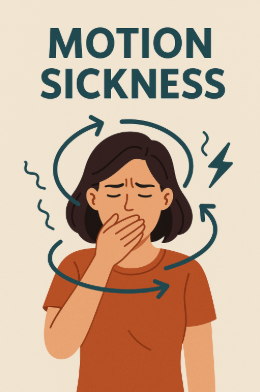
With summer right around the corner, many people are looking forward to making travel plans to visit family, explore new places, or simply enjoy a getaway. However, the initial excitement of the journey can quickly turn into an uncomfortable experience due to motion sickness. Approximately one in three people experience this complex condition, which can occur during air, sea, or road travel, as well as while using virtual simulators. It is believed to be caused by a mismatch between the visual stimulation experienced and the motion signals perceived by the brain. Three main systems work together, contributing to balance and spatial
The most effective way to stop motion sickness is to eliminate movement. However, this is not practical when traveling. Fortunately, prevention tends to be more effective than treating symptoms after they begin, and travelers can benefit from several behavioral strategies to reduce or avoid discomfort.
One of the most important steps in minimizing symptoms is choosing a position that reduces the perception of motion. On airplanes, selecting a seat over the wings can result in a smoother ride because turbulence is generally less noticeable in this area compared to the back or tail of the plane. In cars, sitting in the front passenger seat or driving can help reduce sensory conflict because the visual and vestibular systems are more aligned. Similarly, on boats or cruise ships, being located near the center of the vessel, close to the waterline, and facing the direction of travel can reduce the perception of rocking. In addition, focusing on the horizon provides the brain a stable point of reference. This helps reconcile visual and vestibular input, therefore decreasing disorientation.
Avoiding close-up visual tasks is another important preventive measure. Engaging in activities such as reading, looking at screens, or focusing on nearby objects can worsen symptoms. These tasks cause the visual system to signal stillness, while the vestibular system detects motion, creating a sensory mismatch. To reduce this conflict, it is recommended that travelers focus on distant objects or the external environment, which allows their sensory systems to synchronize better.
Dietary and environmental factors also play a role in managing motion sickness. Consuming small amounts of bland, easily digestible foods such as crackers or canned fruit can help minimize nausea symptoms. Foods that are greasy, spicy, acidic, or overly rich should be avoided as they can worsen symptoms. Hydration is also important, but alcohol consumption should be limited or avoided. Furthermore, wearing loose, comfortable clothing and maintaining a stable body temperature can be beneficial for travelers. Additionally, it's recommended to stay in well-ventilated areas and avoid strong odors that might trigger nausea.
Although medications such as antihistamines and anticoagulants are often used to prevent and alleviate symptoms, they may not always be accessible or suitable for every traveler due to potential side effects. Fortunately, by incorporating practical strategies such as optimal seating, reducing visual-vestibular conflict, eating appropriately, and maintaining physical comfort, individuals can significantly reduce their chance of experiencing motion sickness. These proactive measures offer a non-pharmacologic way to promote a more comfortable and symptom-free travel experience, whether it’s by air, land, or sea.
References:
Brainard, Andrew, MD, MPH, and Chip Gresham, MD. “Prevention and Treatment of Motion Sickness.” American Family Physician, vol. 90, no. 1, 1 July 2014, pp. 41–46.
https://www.aafp.org/pubs/afp/issues/2014/0701/p41.html.
Hayes, Kristin, RN. “How to Prevent Motion Sickness.” Verywell Health, Dotdash Meredith, 11 Apr. 2023,
https://www.verywellhealth.com/how-to-prevent-motion-sickness-1192232.
“Motion Sickness.” MedlinePlus, U.S. National Library of Medicine, 7 July 2015,
https://medlineplus.gov/genetics/condition/motion-sickness/.