The Importance of Monitoring High Blood Pressure
Written By: Ihsaan Alam and Xavier Oyola
High blood pressure is one of the most significant health problems we face globally due to its both serious and silent nature. Many illnesses announce themselves with pain, fatigue, or dramatic symptoms that force us to pay attention. Hypertension often does the opposite. It can be in a dormant state for years, quietly increasing the risk of heart attack, stroke, kidney disease, and vision loss, all while a person feels normal. That is not because the body is fine, but because the damage is gradual. Persistent pressure inside the arteries strains tissues designed to flex, not to endure chronic force at elevated levels. In public health terms, hypertension matters not only because it is dangerous, but because it is common and easy to miss if you are not checking for it.
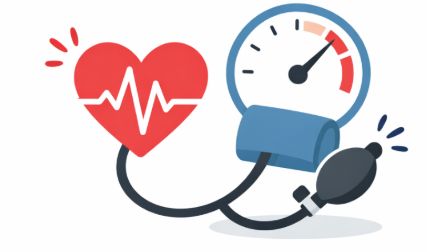
To understand why blood pressure matters, it helps to know how it is typically measured for medical use. A blood pressure reading, such as 120/80 mm Hg, contains two numbers that represent different phases of the heartbeat:
Systolic pressure (top number): The force in the arteries when the heart contracts and pushes blood forward.
Diastolic pressure (bottom number): The force when the heart relaxes between beats.
Together, these numbers describe the workload placed on blood vessels during a complete cardiac cycle. When either number remains elevated over time, arteries experience greater mechanical stress, increasing the risk of damage.
The American Heart Association categorizes blood pressure levels to guide risk assessment, and treatment is as follows:
Normal: Below 120/80
Elevated: 120–129 systolic and under 80 diastolic
Stage 1 Hypertension: 130–139 systolic or 80–89 diastolic
Stage 2 Hypertension: 140 systolic or 90 diastolic and above
Hypertensive Crisis: Over 180 systolic and/or 120 diastolic, especially with symptoms like chest pain, shortness of breath, weakness, or difficulty speaking
An important detail is that the two numbers are not averaged. If either value falls into a higher category, overall cardiovascular risk increases. A lower diastolic number does not cancel out a higher systolic number, because the arteries still endure that higher force during each heartbeat.
The harm from hypertension is best understood as wear-and-tear that accumulates. Arteries are living structures with muscle and elastic tissue that help regulate blood flow. When the pressure is chronically high, vessels can stiffen, and minor injuries to the lining can make it easier for cholesterol and inflammatory cells to form plaques. That process can narrow arteries supplying the heart and brain, increasing the risk of heart attack and stroke.
Hypertension also affects organs that rely on fine, delicate blood vessels. The kidneys, for example, function as filtration units that depend on stable pressures within microscopic capillaries. High pressure can scar these structures and gradually reduce kidney function. The tragedy is that by the time symptoms appear, the underlying changes may already be advanced. This is why clinicians treat blood pressure as a foundational vital sign rather than a minor number.
Because hypertension is often symptomless, screening becomes a powerful tool. The Centers for Disease Control and Prevention notes that nearly half of U.S. adults have high blood pressure, and a significant portion are unaware they have it. That lack of awareness is not a personal failure; it is a predictable consequence of a condition that rarely causes immediate discomfort.
It also explains why routine measurement matters. A single reading is not the whole story, but it is a clue, and patterns over time are what guide decisions. The U.S. Preventive Services Task Force recommends screening for high blood pressure in adults and emphasizes confirming the diagnosis with measurements obtained outside the clinical setting, such as home or ambulatory blood pressure monitoring.
This matters because blood pressure is sensitive to context. Some people register higher readings in medical offices due to stress, sometimes called the white coat effect. Others have acceptable readings in clinics but elevated pressures in daily life. Confirming outside the clinic helps ensure that treatment decisions are based on a person’s typical physiology rather than a single moment of anxiety or an unusually calm appointment.
Once hypertension is identified, the goal is not perfection, and it is not fear. The goal is risk reduction over years and decades. Lifestyle changes can meaningfully lower blood pressure for many people, particularly when they are practical and sustained. Regular physical activity improves vascular function; reducing excess dietary sodium can decrease fluid retention and vascular resistance; adequate sleep supports hormonal regulation; and moderating alcohol intake can lower blood pressure in some individuals.
Measurement technique also matters more than most people realize. Caffeine, nicotine, exercise, and stress shortly before checking can falsely elevate readings. A proper cuff size and a quiet seated rest improve accuracy.
For some people, medication becomes part of the plan, and that should be framed correctly: it is not a sign of weakness, and it does not negate healthy habits. It is a tool that can reduce strain on the cardiovascular system, especially when biology, age, family history, or coexisting conditions make lifestyle changes alone insufficient.
References:
American Heart Association. “Understanding Blood Pressure Readings.” American Heart Association, 14 Aug. 2025, https://www.heart.org/en/health-topics/high-blood-pressure/understanding-blood-pressure-readings.
Centers for Disease Control and Prevention. “High Blood Pressure Facts.” CDC, 28 Jan. 2025, https://www.cdc.gov/high-blood-pressure/data-research/facts-stats/index.html.
U.S. Preventive Services Task Force. “Hypertension in Adults: Screening.” USPSTF, 27 Apr. 2021, https://www.uspreventiveservicestaskforce.org/uspstf/recommendation/hypertension-in-adults-screening.