Understanding Health Literacy and its Importance
Written By: Ihsaan Alam and Mariam Shahzad
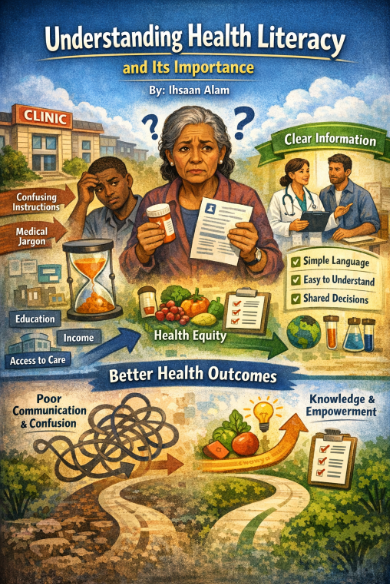
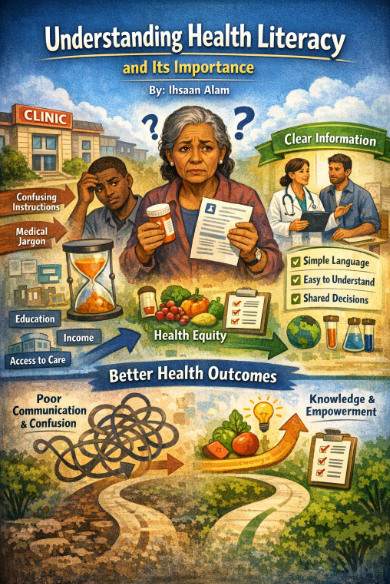
Health literacy is the ability to find, understand, and use health information and services to make decisions that protect your health. It sounds rather straightforward, but it is one of the strongest predictors of whether medical care actually works in real life. A diagnosis does not help if a person cannot make sense of what it means. A prescription cannot prevent complications if the instructions feel like a foreign language. Even a “normal” test result can be misunderstood if patients do not know what was tested, what was not, and what symptoms should still prompt help.
Health literacy also is not just a personal skill. It is shaped by the environment. The CDC explains that health literacy problems often arise because organizations create and deliver information that is too difficult to understand, or because they expect people to navigate services with unfamiliar, confusing, or even conflicting steps (“Understanding Health Literacy”). Harvard’s Mahalingaiah Lab makes this distinction explicit by separating personal health literacy from organizational health literacy, emphasizing that health systems have a responsibility to make information usable, not merely available (Huffman). That framing matters because it replaces the tired idea of “noncompliance” with a more accurate question: did we communicate clearly enough for a human being under stress to act safely?
The consequences of low health literacy are not subtle. In their review of health literacy and disease prevention, Coughlin and colleagues describe how health literacy is tightly linked to social determinants such as education and income, and how limited health literacy can weaken prevention and chronic disease management, including screening uptake and the ability to process complex medical information (Coughlin et al. 1). This helps explain why health outcomes can differ so sharply across communities even when clinics exist nearby. Access alone does not guarantee benefit. People also need guidance that fits their lives, their language, and their level of familiarity with medical terms.
Health literacy becomes most visible when decisions are complex. Modern medicine asks patients to weigh risks, benefits, and tradeoffs, often while afraid or in pain. Shared decision-making only works if patients can understand what is being offered and why. Coughlin and colleagues note that interventions using plain language, simple design, and clear graphics can improve shared decision-making, particularly in disadvantaged populations (Coughlin et al. 1). In other words, clarity is not a cosmetic improvement. It is a clinical intervention.
A health system that takes health literacy seriously treats understanding as part of care. It designs instructions that can be followed at home. It checks comprehension without shaming. It communicates risks in plain terms. It respects that confusion is not a character flaw. Health literacy is how medical knowledge becomes action, and how action becomes better health. When we strengthen it, we reduce preventable harm, improve equity, and make healthcare worthy of the trust it asks from the public.
References:
Centers for Disease Control and Prevention. “Understanding Health Literacy.” CDC, 16 Oct. 2024, www.cdc.gov/health-literacy/php/about/understanding.html
Coughlin, Steven S et al. “Health Literacy, Social Determinants of Health, and Disease Prevention and Control.” Journal of environment and health sciences vol. 6,1 (2020): 3061.
Huffman, Eliana. “Turning Research into Reality: What Is Health Literacy and Why Is It Important?” Mahalingaiah Lab, Harvard T.H. Chan School of Public Health, 6 Oct. 2025, hsph.harvard.edu/mahalingaiah-lab/news/turning-research-into-reality-what-is-health-literacy-and-why-is-it-important/. Accessed 29 Dec. 2025.