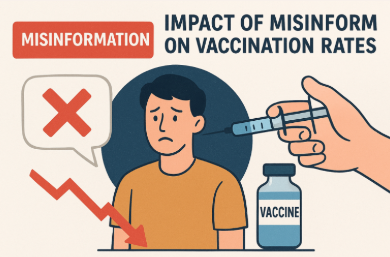
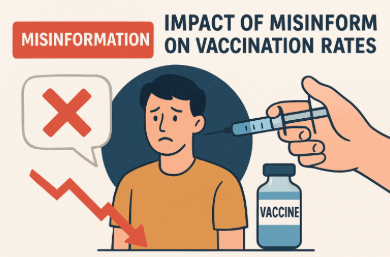
The Impact of Misinformation on Vaccine Rates
Written By: Rhea Mittal and Xavier Oyola
The rampant increase of vaccine misinformation over the past couple of years poses a significant threat to public health by eroding confidence, increasing hesitancy, and ultimately reducing vaccination rates. Despite the proven benefits of immunization, false and misleading narratives about vaccines persist and, in many cases, are gaining ground faster than public health efforts to counter them.
According to a review led by researchers at the Columbia University Mailman School of Public Health, the volume of anti-vaccine messages circulating on social media has grown at a pace that outstrips the capacity of interventions to keep up. The authors emphasize that while some debunking or “pre-bunking” efforts show promise, the high volume of misinformation means that simply providing accurate information is often insufficient. Their key findings include that successful messaging must engage cultural values such as autonomy, protecting loved ones, and trusting community voices, rather than focusing solely on facts about vaccine safety and efficacy.
A peer-reviewed study also links misinformation directly to lower vaccination rates. Researchers found a significant relationship between the amount of fake news exposure and the number of vaccine doses administered. In short, where misinformation is prevalent, vaccination uptake suffers. The authors caution that establishing causality is complex due to the presence of confounders, but the directional evidence is persuasive.
The stakes are exceptionally high when it comes to childhood immunizations. A recent report highlights the resurgence of preventable diseases such as measles in the US, partly enabled by drops in routine immunization and by erosion of confidence in vaccines. Although most adults correctly identify claims such as “the measles vaccine is more dangerous than the measles infection itself” as false, a significant fraction remain uncertain. Four in ten say that they are only “probably false.” This uncertainty creates a group of people susceptible to being misled by false statistics, regardless of their accuracy.
These reports paint a consistent picture that misinformation undermines both belief in vaccine safety/necessity and intention to vaccinate, with measurable effects on uptake rates. The Columbia Review emphasizes that the sheer volume of misinformation can overwhelm reliable information, making interventions less effective. With half of adults in one poll willing to categorically reject false vaccine claims, a vulnerable middle ground of people remains.
Beyond statistics, the impact of lower vaccination rates is real, with increased risk of outbreaks, the spread of preventable diseases, and the resurgence of illnesses that had been under control. When vaccine coverage drops, herd immunity weakens, and the gains of past public health campaigns are at risk.
The Columbia Review recommends moving beyond fact-based messaging to strategies that build trust, engage influential local voices, and monitor public attitudes in real-time via social listening data. Another suggestion is tailored communication, such as addressing specific misinformation themes and understanding audience segmentation. Empirical data suggest that interventions should prioritize places and populations with high exposure to misinformation.
Ultimately, combating vaccine misinformation is not merely a matter of presenting correct facts, but also about trust, culture, values, and information systems. Without sustained efforts to engage these dimensions, misinformation will continue to lower vaccination rates. Public health systems must adapt by tracking evolving misinformation narratives, partnering with social platforms, and engaging communities proactively rather than reacting. The cost of inaction is high for individuals, communities, and global health.
References:
“Vaccine Misinformation Outpaces Efforts to Counter It.” Columbia University Mailman School of Public Health, 17 Oct. 2023, https://www.publichealth.columbia.edu/news/vaccine-misinformation-outpaces-efforts-counter-it.
Mheidly, Nassr, and Jawad Al Samaan. “The Prevalence and Impact of Fake News on COVID-19.” Journal of Public Health Research, vol. 11, no. 3, 2022, article 2273, PubMed Central (PMC), https://pmc.ncbi.nlm.nih.gov/articles/PMC9045486/.
“Vaccine Misinformation Spreads as Children Head Back to School.” KFF Health Information & Trust Initiative, 18 Aug. 2023, https://www.kff.org/health-information-trust/vaccine-misinformation-spreads-as-children-head-back-to-school/.