The Benefits of Vitamin D
Written by: Mariam Shahzad and Rhea Mittal
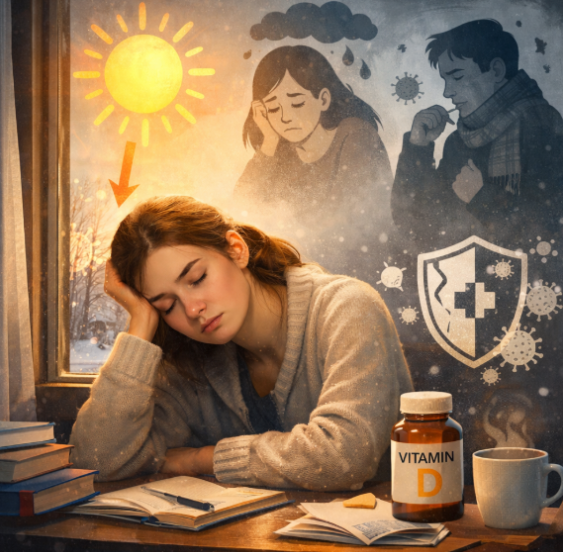
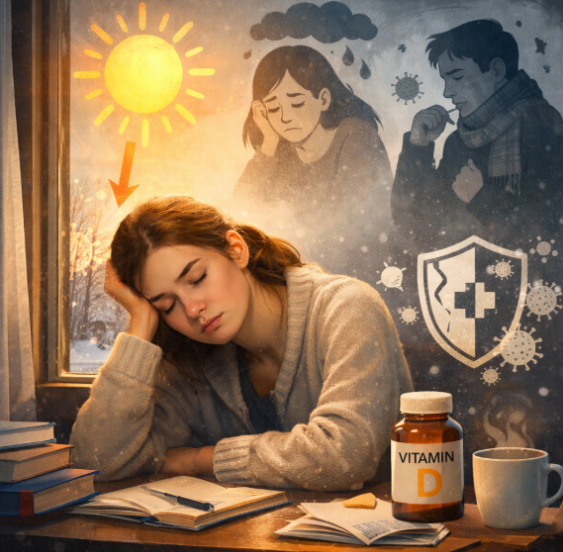
Winter just feels exhausting. The days are shorter, it gets dark way too early, and a lot of people feel tired even when they’re doing everything “right.” You hear people say they’re unmotivated, burnt out, or just not feeling like themselves. Most of the time we blame stress or our schedules, but there’s also a physical reason that doesn’t get talked about enough: vitamin D.
Vitamin D is made when your skin is exposed to sunlight, which can become a problem in the winter. Between classes, work, and being inside most of the day, it’s easy to go weeks barely seeing the sun. Over time, vitamin D levels drop, and that can affect both mood and physical health, even if people don’t immediately connect the two.
A lot of people notice their mood gets worse in the winter. Feeling low, tired, or foggy starts to feel normal. Vitamin D is connected to serotonin, which helps regulate mood, so when vitamin D levels are low, mood can take a hit, too. The National Institutes of Health has found that low vitamin D levels are linked to a higher risk of depressive symptoms, especially during seasons with limited sunlight. That doesn’t mean winter depression is “just vitamin D,” but it helps explain why winter can feel heavier for no clear reason.
Vitamin D also affects the immune system. When levels are low, people can feel constantly run down or notice they’re getting sick more often. The Centers for Disease Control and Prevention has linked vitamin D deficiency to increased risk of respiratory infections, which already spread more easily in winter. Being sick more often only adds to fatigue and stress, and it can start to feel like you never fully recover.
Some people are more affected than others. Students are a big one. Between long days indoors, irregular eating habits, and barely any time outside, it’s easy for vitamin D levels to drop. Feeling exhausted or unmotivated gets brushed off as “college life,” even when there may be more going on. Healthcare workers deal with similar issues, especially during long shifts with little daylight exposure and high stress.
People of color are also at higher risk for vitamin D deficiency. Higher melanin levels reduce how much vitamin D the skin produces from sunlight, meaning deficiency can happen even with similar sun exposure. Harvard T.H. Chan School of Public Health points out that vitamin D deficiency is more common in individuals with darker skin, particularly in colder climates where sunlight is already limited.
Vitamin D deficiency isn’t always obvious. Feeling tired, low, or sick more often is easy to blame on winter itself. But paying attention to vitamin D can actually help. Whether it’s getting outside when possible, being more mindful of diet, or talking to a healthcare provider about supplements, small changes can make a difference. It’s not a fix for everything, but it’s one factor that’s worth thinking about when winter starts to feel overwhelming.
References:
National Institutes of Health. “Vitamin D and Health.” Office of Dietary Supplements, National Institutes of Health, https://ods.od.nih.gov/factsheets/VitaminD-HealthProfessional/.
Centers for Disease Control and Prevention. “Vitamin D Deficiency.” CDC, U.S. Department of Health and Human Services, https://www.cdc.gov/nutritionreport/vitamind_deficiency.html.
Harvard T. H. Chan School of Public Health. “Vitamin D.” The Nutrition Source, Harvard University, https://www.hsph.harvard.edu/nutritionsource/vitamin-d/.
Martineau, Adrian R., et al. “Vitamin D Supplementation to Prevent Acute Respiratory Infections: Systematic Review and Meta-Analysis of Individual Participant Data.” BMJ, vol. 356, 2017, https://www.bmj.com/content/356/bmj.i6583.
Kerr, Douglas C. R., et al. “Association of Vitamin D Levels With Depressive Symptoms in Adults.” JAMA Psychiatry, vol. 72, no. 10, 2015, pp. 1024–1032, https://jamanetwork.com/journals/jamapsychiatry/fullarticle/2339073