Part 2: The Global Public Health Response to the MV Hondius Hantavirus Outbreak
Written by: Eshrat Quader, Laila Ibrahim, and Sahannah Seemungal
The recent outbreak linked to the cruise ship MV Hondius has drawn significant international attention as public health agencies continue investigating the incident and monitoring exposed travelers across multiple countries.
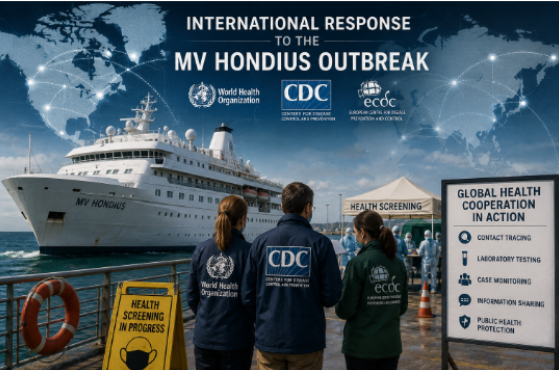
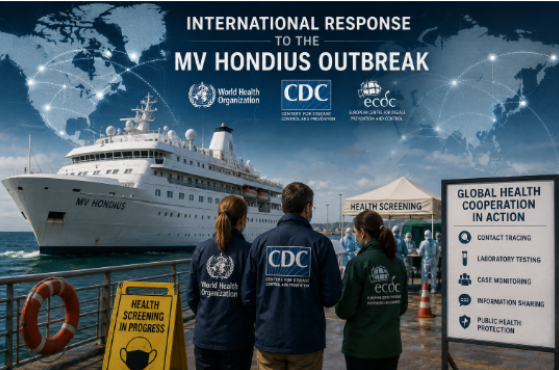
The outbreak has become a major topic of discussion among global health officials because the ship carried passengers and crew members from over 20 countries, requiring extensive international coordination between healthcare systems and public health agencies. Organizations including the World Health Organization (WHO), the Centers for Disease Control and Prevention (CDC), and the European Centre for Disease Prevention and Control (ECDC) have remained actively involved in contact tracing, monitoring, and communication efforts since the outbreak was first identified.
The situation has highlighted some of the unique public health challenges associated with cruise ship travel. Because passengers remain in close quarters for extended periods while traveling between countries, outbreaks can become more difficult to track and manage. International travel also complicates communication between healthcare systems, particularly when exposed passengers return to different countries requiring separate monitoring protocols and follow-up procedures.
Health officials have emphasized the importance of rapid communication and coordinated surveillance during incidents involving international travel. Public health agencies continue sharing information regarding possible exposures, patient monitoring, and laboratory testing while attempting to prevent further spread.
The outbreak has also generated widespread discussion online, with some social media users comparing the situation to the beginning stages of the COVID-19 pandemic. However, public health experts continue stressing that the overall public risk remains low and that the current outbreak does not present the same level of transmission concern associated with highly contagious respiratory viruses.
Despite growing media attention, WHO has not recommended travel restrictions related to the outbreak. Instead, officials continue encouraging awareness, precautionary measures, and reliance on reputable scientific information while investigations remain ongoing.
Experts also note that public response during infectious disease events can significantly influence how outbreaks are managed. Misinformation and fear-based reporting may contribute to unnecessary panic, making clear communication from healthcare professionals and public health organizations especially important during evolving situations.
The MV Hondius outbreak continues to serve as an example of how interconnected global travel has become and how quickly public health concerns can gain international attention. While investigators continue monitoring the situation, health agencies maintain that continued surveillance, public awareness, and coordinated response efforts remain the most effective tools for preventing further spread.
References:
CDC. “About Hantavirus.” Hantavirus, 13 Mar. 2025, www.cdc.gov/hantavirus/about/index.html?utm_source=.
Christensen, Jen. “What the Numbers Tell Us about Hantavirus.” CNN, 8 May 2026, www.cnn.com/2026/05/08/health/hantavirus-by-the-numbers?utm_source=.
Martínez, Valeria P., et al. ““Super-Spreaders” and Person-To-Person Transmission of Andes Virus in Argentina.” New England Journal of Medicine, vol. 383, no. 23, 3 Dec. 2020, pp. 2230–2241, https://doi.org/10.1056/nejmoa2009040.
“Hantavirus Cluster Linked to Cruise Ship Travel, Multi-Country.” Who.int, 2024, www.who.int/emergencies/disease-outbreak-news/item/2026-DON599?utm_source=..