Cognitive Engagement and the Prevention of Dementia
Written By: Ihsaan Alam and Sahannah Seemungal
Cognitive engagement may play an important role in preserving brain health and reducing the risk of dementia, including Alzheimer’s disease. Dementia is not a single illness but a syndrome marked by progressive decline in memory, reasoning, language, attention, or other abilities that eventually interferes with daily life. Alzheimer’s disease is the most common cause, but vascular disease and other neurological conditions may also contribute. Although no puzzle, application, or mental exercise can guarantee prevention, growing evidence suggests that sustained cognitive activity may help the brain remain functional for longer.
One explanation is the concept of cognitive reserve. Cognitive reserve refers to the brain’s ability to cope with age-related or disease-related changes while maintaining performance. Education, intellectually demanding work, social interaction, and lifelong learning may help strengthen this reserve by encouraging the brain to use existing networks more efficiently or recruit alternative pathways. This does not mean cognitive activity prevents the biological changes associated with Alzheimer’s disease. Instead, it may delay the point at which those changes become noticeable in everyday life.
The ACTIVE trial, one of the strongest long-term studies of cognitive training in older adults, provides encouraging evidence. Participants received training in memory, reasoning, or visual processing speed. A later analysis found that those who completed adaptive speed-of-processing exercises and booster sessions had a 25% lower rate of claims-based Alzheimer’s disease and related dementia diagnoses over approximately 20 years compared with a control group (Coe et al., 2026). These exercises required participants to identify visual information quickly while dividing their attention, and the difficulty increased as their performance improved.
The findings are promising, but they should be interpreted carefully. The apparent benefit was linked to a specific form of adaptive training, not to all brain games. Memory and reasoning training did not produce the same significant reduction, and dementia diagnoses were identified through Medicare claims rather than detailed neurological examinations, brain imaging, or biological testing. The study therefore supports further research into targeted cognitive training, but it does not justify claims that every crossword puzzle or commercial brain-training program prevents dementia.
Another important distinction is the difference between improving at a practiced task and improving broader cognitive function. Repeating the same puzzle may make a person faster or more accurate at that puzzle, but it may not improve medication management, financial decision-making, driving, or other everyday abilities. A systematic meta-review of cognitive interventions in healthy older adults found benefits in memory, attention, and processing speed. Still, the quality of the evidence varied, and the long-term effect on dementia risk remained uncertain (Velloso et al., 2025).
The most useful cognitive activities are likely those that are novel, active, progressively challenging, and sustained over time. Learning a language, playing a musical instrument, studying a new subject, planning a complex event, solving strategy-based problems, or mastering unfamiliar technology can engage several abilities at once. Activities that require recalling, explaining, adapting, and making decisions are generally more demanding than passive reading or watching. Teaching, volunteering, and group learning may be especially valuable because they combine mental stimulation with social connection.
Meaning also matters. A person is more likely to continue an activity that feels enjoyable, purposeful, or socially rewarding. For one person, that may involve learning family recipes; for another, it may mean joining a book club, taking a class, practicing an instrument, or helping a grandchild with homework. The goal is not simply to stay busy but to participate in activities that require attention, effort, learning, and adaptation.
Cognitive engagement should still be viewed as only one part of dementia prevention. The 2024 Lancet Commission estimated that approximately 45% of dementia cases worldwide may be preventable or delayable through attention to multiple modifiable risk factors. These include limited education, hearing and vision loss, hypertension, diabetes, smoking, depression, physical inactivity, social isolation, traumatic brain injury, high cholesterol, excessive alcohol use, obesity, and air pollution (Livingston et al., 2024). Mental exercises cannot fully compensate for untreated cardiovascular disease, severe social isolation, or sensory loss.
Cognitive exercises should also never replace medical evaluation. New difficulties managing appointments, finances, medications, familiar routes, or everyday responsibilities may have several causes, some of which are treatable, and should be discussed with a qualified health professional.
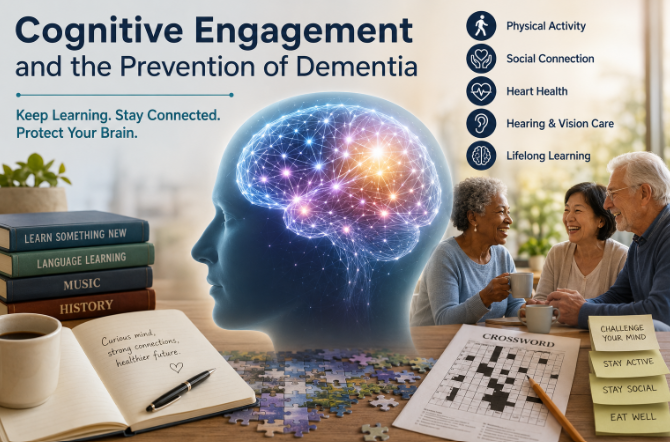
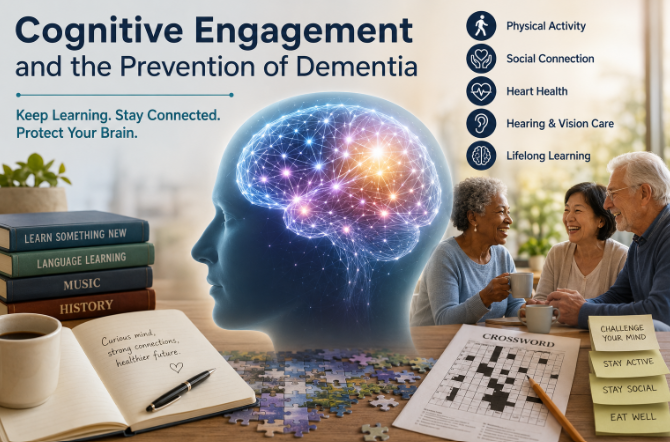
A balanced approach therefore combines continued learning with physical activity, strong social relationships, hearing and vision care, and management of conditions such as high blood pressure and diabetes. Cognitive tasks may not prevent Alzheimer’s disease outright, but they can contribute to a more resilient brain. The most effective strategy is not to search for one perfect game, but to keep learning, remain socially connected, protect physical health, and challenge the mind throughout life.
References:
Coe, N. B., Miller, K. E. M., Sun, C., Taggert, E., Gross, A. L., Jones, R. N., Felix, C., Albert, M. S., Rebok, G. W., Marsiske, M., Ball, K. K., & Willis, S. L. (2026). Impact of cognitive training on claims-based diagnosed dementia over 20 years: Evidence from the ACTIVE study. Alzheimer’s & Dementia: Translational Research & Clinical Interventions, 12(1), Article e70197.
Livingston, G., Huntley, J., Liu, K. Y., Costafreda, S. G., Selbæk, G., Alladi, S., Ames, D., Banerjee, S., Burns, A., Brayne, C., Fox, N. C., Ferri, C. P., Gitlin, L. N., Howard, R., Kales, H. C., Kivimäki, M., Larson, E. B., Nakasujja, N., Rockwood, K., … Mukadam, N. (2024). Dementia prevention, intervention, and care: 2024 report of the Lancet Standing Commission. The Lancet, 404(10452), 572–628.
Velloso, V., Latgé-Tovar, S., Bomilcar, I., & Mograbi, D. C. (2025). Cognitive interventions for healthy older adults: A systematic meta-review. International Journal of Clinical and Health Psychology, 25(1), Article 100538.